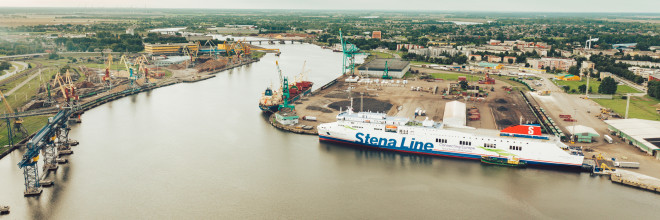
The Ventspils Freeport Authority has signed a contract for the construction of a shore power connection point at the ferry terminal of the Port of Ventspils. This will be the first berth in the port of Ventspils where ferries will be able to use a high-capacity shore power supply point.
Ships visiting the Port of Ventspils currently use diesel-powered generators, which emit greenhouse gases and increase the noise level. Since several berths in the port are located close to residential areas, it is essential to introduce climate- and environment-friendly alternatives in port operations. By implementing a shore power supply point, air quality in Ventspils will be improved, as ferries will be able to use electricity from a shore connection while staying in the port.
Berth No. 16 was built in 2000, and it provides mooring and handling services for ferries and other passenger vessels. The berth is currently actively used by Stena Line ferries, which operate on the Ventspils–Nynäshamn (Sweden)–Ventspils route. The ferry connection from Ventspils to Sweden is the shortest maritime link between the Baltic States and the Stockholm region, ensuring the most efficient and high-capacity logistics route to the Scandinavian market.
Acting CEO of the Ventspils Freeport Authority, Igors Udodovs pointed out that regular shipping lines are one of the development priorities of the Port of Ventspils. “Shore electrification is a necessity for a modern port. We are pleased that with the opportunities provided by European Union funds and the interest of our major client Stena Line, we can move forward step by step in developing port infrastructure while simultaneously reducing environmental pollution risks,” emphasized Udodovs.
“The electrification of the ferry terminal in Ventspils marks a significant milestone in our objective of sustainable maritime transport in the Baltic Sea. As one of the leading ferry operators in Europe, Stena Line is proud to support initiatives that reduce emissions and promote cleaner operations in ports. This investment not only strengthens Ventspils as a key gateway between Latvia and Sweden but also demonstrates how collaboration between ports, industry partners, and the EU can accelerate our shared journey toward more sustainable future.” said Liene Lemane, Trade Director at Stena Line, Business Region Baltic Sea North.
As a result of an open tender, the rights to sign the contract for constructing the power connection point were obtained by “RPI-ISP”—a supplier consortium formed by the companies RP Infra and Industry Service Partner. The contract amount is almost four million euros, excluding VAT. The construction works will include the installation of a shore power supply point with a total capacity of 4000 kW, providing connection to a RO–PAX (cargo–passenger) vessel. Currently in force is Regulation (EU) 2023/1804 on Alternative Fuels Infrastructure (AFIR), which together with the FuelEU Maritime Regulation requires that by 2030 all regularly operating passenger and container vessels in TEN-T (Trans-European Transport Network) ports must have access to electricity.
The construction of the power connection point at Berth 16 of the Port of Ventspils is part of the electricity infrastructure reconstruction project for three berths—Nos. 14, 15, and 16—planned in three independent stages. The first stage of the construction project, the reconstruction of Berth 16, will be implemented within the project “Renovation of the Ventspils Freeport Vessel Traffic Management Centre and Electrification of Berths” as one of the project’s two activities. The second activity involves restoring the port’s vessel traffic management system, including the supply and installation of monitoring, communication, and control equipment necessary for vessel traffic, as well as the renovation, reconstruction, and construction of structures required for installing this equipment.
The project is being implemented within the framework of the European Union Cohesion Fund. The total eligible costs of the project are EUR 4,018,579.41, of which EUR 3,415,792.50 is financed by the Cohesion Fund. The project implementation period runs until 31 December 2029.